Listen Now
Vaccines can feel overwhelming for new parents. Between shifting guidelines and strong opinions coming from all directions, it can be hard to know who to trust.
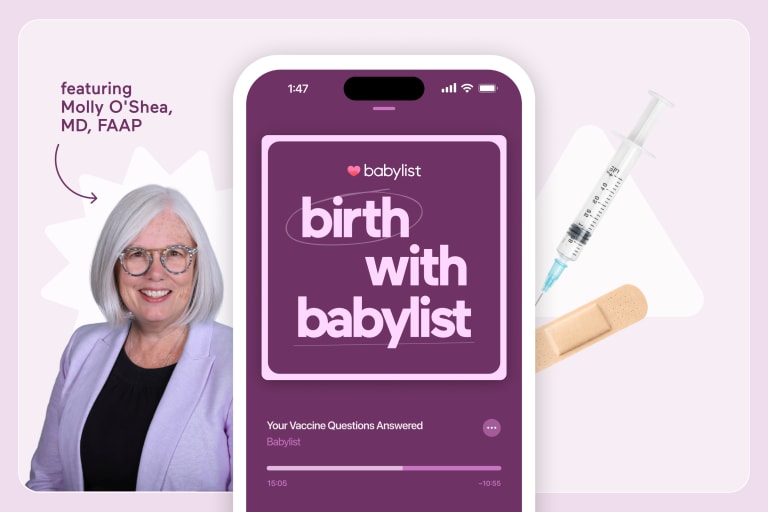
In this episode, we cut through the noise with pediatricians Dr. Florencia Segura and Dr. Molly O'Shea. We cover everything: from vaccines needed during pregnancy and your baby's first-year schedule, to understanding the new RSV vaccine and how exactly vaccines work, we'll help you navigate these medical decisions with confidence and clarity.
Birth with Babylist brings together trusted experts and parents who’ve lived it to break down what happens before, during, and after birth—without fear-mongering or shaming. Hosted by journalist, author, and mom of three Jo Piazza. Follow so you never miss an episode.
Jump to Key Topics
Vaccines during pregnancy
(1:36) Getting vaccinated during pregnancy is a routine part of prenatal care. The Tdap, flu, RSV and COVID vaccines aren’t just to protect your health—they also pass protective antibodies right to your baby, which help shield them during those first few vulnerable months before they can get their own vaccines.
Recent changes in recommendations
(4:19) Lately, vaccine guidelines seem to be constantly shifting as recent court rulings have overturned certain CDC updates. To cut through the noise, most pediatricians recommend following the American Academy of Pediatrics (AAP) schedule to give your baby maximum protection exactly when they need it most.
Who to trust
(5:46) When opinions are coming from all directions—especially on social media—your pediatrician is your most reliable source for medical information based on real data, experience and the relationship they’ve already formed with you. Doctors actually want you to share all your questions and concerns with them, so they can work with you and your family’s needs to keep your baby healthy.
How vaccines work
(7:48) Once your baby leaves the sterile environment of the womb, they can be exposed to all sorts of viruses and bacteria. Vaccines safely introduce a tiny piece of a virus's protein so that your baby's body can build an immune response in a controlled way, without ever having to face the full force of an infection.
Baby’s first vaccines
(9:55) Your pediatrician will walk you through every single shot your baby gets, but the general breakdown is:
-
At birth, the AAP highly recommends a Hepatitis B vaccine
-
At two, four and six months, baby gets combination shots for DTaP (diphtheria, tetanus and pertussis), Hib (Haemophilus), pneumococcal, rotavirus and polio
-
At 12 months, baby gets vaccines for MMR (measles, mumps and rubella), chickenpox, and Hepatitis A
-
Along the way, baby will also receive booster shots of Hep B
Safety and side effects
(22:06) Pediatricians emphasize that these FDA-regulated vaccines are totally safe, and a low-grade fever or mild swelling for one to two days is a perfectly normal immune response in both babies and pregnant women.
The RSV vaccine
(24:23) The new RSV vaccine works a little differently than the other vaccines your baby gets—it’s an antibody shot that gives your baby direct immunity instead of making their own body do the work. It can be given during pregnancy (to protect both you and baby) or directly to your baby after they’re born, providing strong coverage during those first six months when they're most vulnerable. But keep in mind that its effectiveness declines over time, and it only lasts about six months.
Making shots easier
(25:59) Shot day is usually harder for parents than for baby, so pediatricians recommend leaning into distractions like nursing, offering a bottle or singing songs to baby during the appointment. They also strongly recommend not giving baby Tylenol or other pain relievers, since it can actually reduce baby’s immune response—better to save it for later in the day if baby gets fussy.
Featured Experts
Molly O’Shea, MD, FAAP is a pediatrician, keynote speaker and strategic advisor with over 30 years in private practice. She is the founder of Birmingham Pediatrics and Campground Pediatrics, and has consulted for a wide range of other organizations. A former media spokesperson for the American Academy of Pediatrics, she also authored the "Ask the Pediatrician" column at The Detroit News and has been recognized six times as a top pediatrics physician in the Detroit area. You can follow her at @doctormollyoshea.
Florencia Segura, MD is a board-certified pediatrician and fellow of the American Academy of Pediatrics. She joined Einstein Pediatrics in Northern Virginia in 2018 and previously practiced at the Children’s Hospital of Philadelphia. Dr. Segura has a special interest in newborn care, childhood nutrition, eczema management and adolescent health. A dedicated educator and children’s health advocate, she mentors medical students, contributes to major media outlets and supports SUDC awareness and research through the SUDC Foundation. You can follow her at @drflorenciasegura.
Check Out More Episodes